






Markets in Crypto-Assets Regulation: webinar gratuito il 15 settembre
The Status Quo, Regulatory Gaps and the Road to MiCA 2. September 15 @ 11:00 am – 12:30 pm CEST
Webinar gratuito in lingua inglese a cura dell’associazione BETTER FINANCE (Bruxelles)
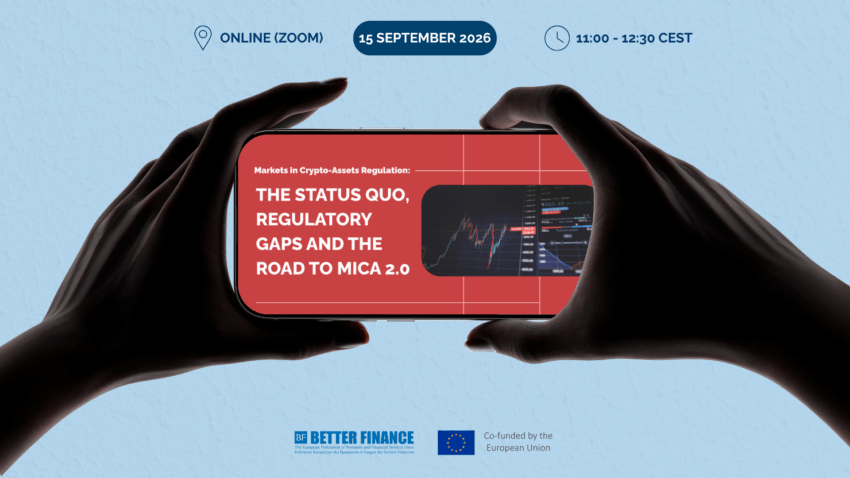
Date: 15 September 2026 | Time: 11:00 – 12:30 CEST | Location: Online
The Markets in Crypto-Assets Regulation positioned the European Union as the first major jurisdiction to establish a comprehensive regulatory framework for crypto-assets.
However, implementation has also exposed legal uncertainties, practical inconsistencies and potential gaps in investor protection. At the same time, rapid technological and market developments are already testing whether the current framework remains sufficiently clear, proportionate and effective.
Le notizie piu' importanti di finanza, economia e mercati, dritte nella tua inbox.
Under these circumstances, the European Commission’s targeted consultation provides an important opportunity to assess how MiCA is functioning in practice and which issues may need to be addressed in a future review of the framework, often referred to as “MiCA 2.0”.
To discuss such an issue, BETTER FINANCE is organising a webinar:
Markets in Crypto-Assets Regulation
The Status Quo, Regulatory Gaps, and the Road to MiCA 2.0
This webinar brings together leading academics, legal experts and investor-protection specialists to examine three areas with particular relevance for policymakers and supervisory authorities:
- – the scope and application of the MiCA white-paper requirements;
- – the effectiveness of the current investor-protection framework; and
- – the implementation of MiCA’s sustainability-disclosure requirements by crypto-asset service providers.
The speakers will combine legal analysis with new empirical findings from the European crypto-asset market. The discussion will conclude with concrete policy takeaways for legislators, regulators, supervisory authorities and other stakeholders involved in the further development of the EU crypto-asset framework.
Programme
11:00 – 11:05 | Welcome & Introduction
Opening remarks and brief introduction to the MiCA consultation
Prof. Christos Gortsos, President of the Academic Board of the European Banking Institute (EBI), Member of the Board of Appeal of the European Supervisory Authorities (ESAs).
11:05 – 11:35 | Expert Presentation
MiCA White Papers: Who needs them under what conditions and what are the legal challenges arising?
Prof. Filippo Annunziata, Professor of Financial Markets and Banking Legislation at Bocconi University
Thomaz B. de Arruda, Lawyer
11:35 – 11:55 | Expert Presentation
MiCA White Papers and Investor Protection: Does the Current Framework Deliver?
Christiane Hölz, Chair of Legal Committee, BETTER FINANCE
11:55 – 12:15 Expert Presentation
ESG Disclosures under MiCA: Public Website Compliance and Formal Alignment in the CASP Market
Prof. Dr. Christoph Kreiterling, Professor of Technology Impact Assessment and Sustainability Communication at Trier University of Applied Sciences, former Senior Adviser and MiCA team co-lead at BaFin
12:15 – 12:30 | Q&A & Policy Takeaways
Christiane Hölz, Chair of Legal Committee, BETTER FINANCE
**
To attend the webinar, please register via the form below. You will receive the link, a few days prior to the webinar.
 Articolo pubblicato con l’ausilio del sistema di Redazione AI AGENTICA di Datamoney, e supervisione umana finale.
Le notizie più lette su LaMiaFinanza










 ✨ Classifica generata dalla Agentic AI (REDAZIONE AI) di Datamoney.ch
 VIDEO INTERVISTE
 Motori
 REAL ESTATE
 LMF crypto
 LMF food
 LMF private markets
 LMF arte
 Legal
Legal LMF green